The Cross-Platform Landscape in 2026
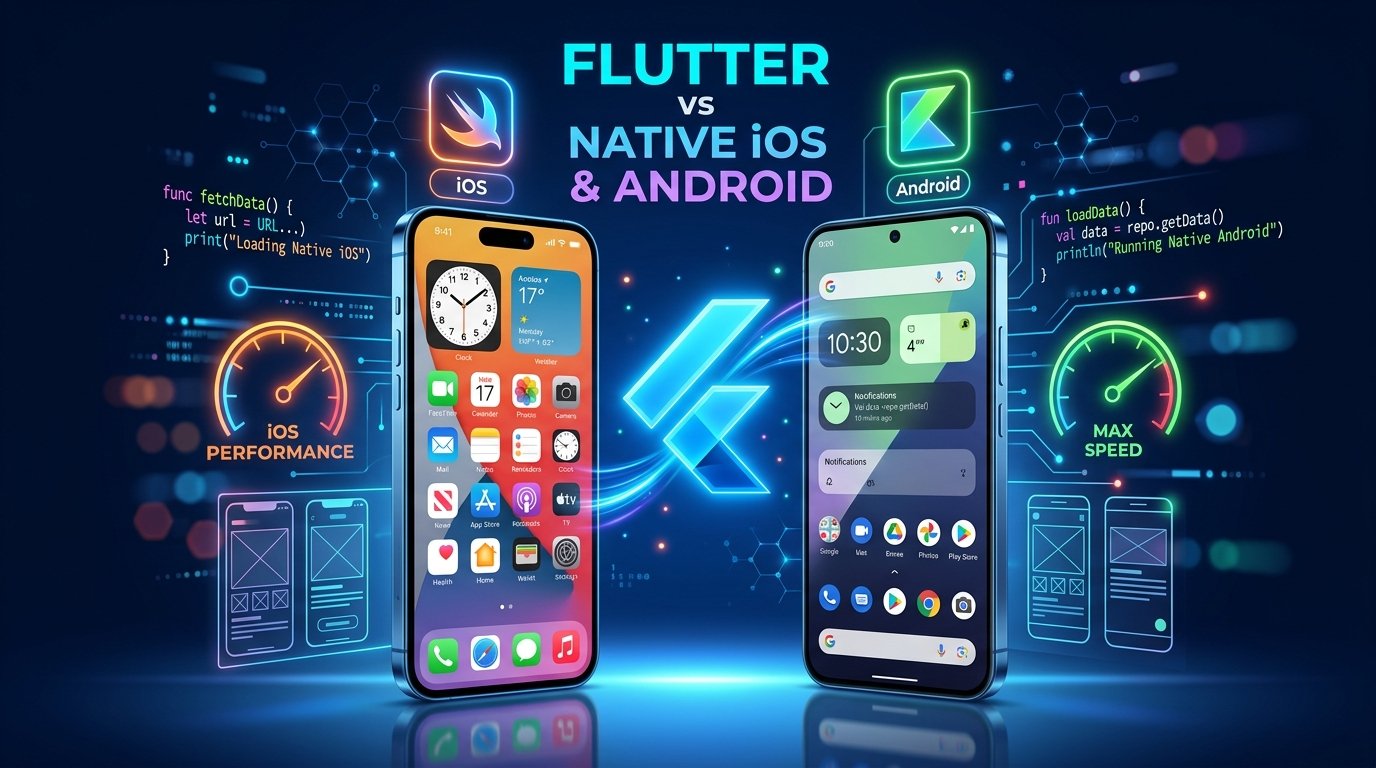
When engineering customer-facing or internal enterprise mobile applications, technical leaders face an enduring question: Do we build two distinct native apps in Swift (iOS) and Kotlin (Android), or unify our frontend codebase with Google's Flutter framework?
1. Development Speed: The Single Codebase Advantage
Traditional native development requires two separate engineering squads, two QA lifecycles, and simultaneous management of divergent feature release cadences. Flutter consolidates this into one shared Dart codebase that compiles directly to native ARM machine code on both platforms.
- 40-50% Reduction in Time-to-Market: Build features once, review once, and deploy simultaneously to Google Play and the Apple App Store.
- Guaranteed Visual Parity: Eliminate pixel discrepancies between iOS and Android versions using Flutter's dedicated Skia / Impeller rendering engine.
- Reduced Long-Term Maintenance: Bug fixes and security patches apply instantly across all mobile operating systems.
2. Performance Benchmarks: Has Flutter Bridged the Gap?
With the maturation of Flutter’s Impeller rendering engine, historical compilation stutters (shader compilation jank) are completely eliminated. Modern Flutter applications achieve steady 60fps to 120fps refresh rates on modern OLED devices, rivaling purely native UI performance.
3. When Native Development is Still Recommended
Native Swift or Kotlin remains the superior choice in select edge cases:
- Heavy AR/VR applications deeply dependent on Apple ARKit or Android ARCore.
- Low-level Bluetooth/BLE hardware pairing protocols with bespoke firmware.
- Complex background sensor monitoring requiring OS-specific kernel threading.
For 95% of commercial applications—including FinTech portals, e-commerce storefronts, delivery tracking apps, and internal company CRM dashboards—Flutter delivers exceptional performance at roughly half the engineering capital expenditure.